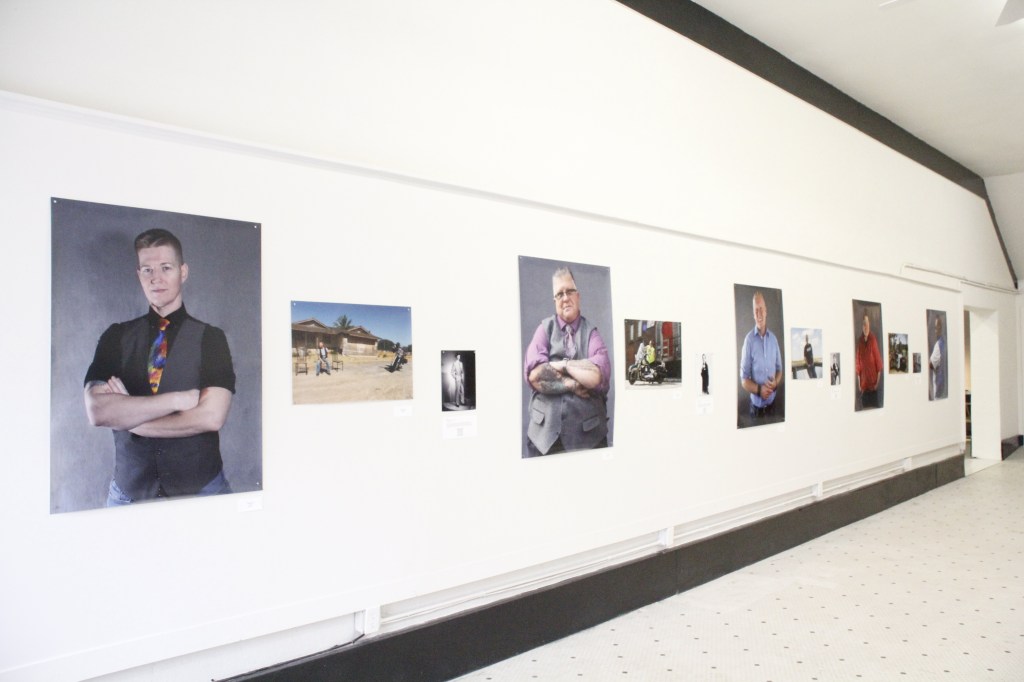
WILSON N.C — Theresa Scott, art professor at Barton College, showcased her latest series, The Disappearing Butch, on Mar. 5 at the opening reception at the Eyes on Main Street Gallery in Wilson, North Carolina.
Artist of both No One Left Behind and The Worst Call, Scott launched The Disappearing Butch, back in Apr. 2021.
She said that The Disappearing Butch stemmed from the pushback from society and reactions she would received, based on how she identifies as a lesbian, who is masculine, on a daily basis.
“From my everyday life, the most absurd [reaction I got was] from a fast-food restaurant here in Wilson. Only a week or two from that, people in our community started to ask my wife if I was transitioning,” said Scott.
Scott recalled another moment that affected her life.
“20 years ago, I had a barber who didn’t want to cut my hair the way I wanted him to because he thought ‘all women were going to start looking like men,’” she said.
Scott said that despite age, people don’t realize that moments are damaging to the mind.
“So it got me thinking, ‘when was the last time I saw somebody that looked like me? Are butch lesbians disappearing?’” she said.
After reflections, Scott found the purpose to create the project from the lingering issue.
Scott said that people constantly questioned whether The Disappearing Butch was necessary.
“While [the LGBTQIA+ community] has come so far — we have marriage equality and whatnot, that doesn’t dismiss the fact of how we’re looked at and treated in public. That’s not gone. That bias is not gone from our society, so yes, it’s still needed,” said Scott.
The Disappearing Butch is an exhibition that consists of 11 different women, These woman, in their mid-30s, range from various backgrounds, ethnicities, and races. Each woman is posed in portraits and candid lifestyle photos of themselves that illustrate their passions.
Scott said that the exhibition also contains audio components, historical elements, and research.
“After going through the institutional review board, and having them approve the research project, I used social media and my website to find participants,” said Scott.
However, it wasn’t long until Scott found herself struggling to find participants.
“After I was having a hard time getting participants interested in North Carolina, I grabbed my traveling kit and took a motorcycle trip back home to Wyoming,” said Scott.
“Over the summer, I posted the call on this lesbian motorcycle page instead and ended up getting like five or six people who contacted me,” she said.
Scott backtracked and said that the audio component of the exhibition are recorded interviews from the participants.
“They include what our personal pushbacks are,” said Scott.
A couple of questions that participants answered were, what is “butch?” and what does “butch” mean to them?
“A lot of the participants talk about what it was like growing up being what we would call tomboys and having their families not like that,” said Scott.
“It’s interesting to see that that’s about the one spot that we vary with our stories and what that word means,” she said.
Scott said that the meaning of the term “butch” has changed.
“In the 70s, it used to mean one specific thing, and now it’s just kind of like a lot of us are just kind of like we are who we are; and that’s just it,” said Scott.
“We like dressing a certain way and presenting a certain way. We don’t care what society says we should do or be. So that’s what it means to be Butch. I was curious about development and what it was like for others,” she said.
Scott said that she was surprised to hear the collective responses to some of the questions asked.
“A lot of the participants said that it might not be so much disappearing as it is. We’re using different labels, and not everyone identifies with that 1970s butch,” said Scott.
“Now it’s like masculine center or gender fluid or gender non-conforming or gender non-conforming rather than gender fluid. But it still amazed me at how many people did not want to participate due to that label,” she said.
Scott said that she hoped her expectations regarding the project would become a reality.
“When people see my work, I hope they realize all the history behind [the term] butch, and are less judgmental towards us,” said Scott.
“There aren’t many of us around, not compared to the rest of the population. We make up a small demographic of the LGBTQ+ community,” she said.
Scott said that LGBTQIA+ representation at a young age is important.
“As you’re growing up and start to realize that you’re a lesbian or homosexual, you start realizing that there might not be others maybe like you,” said Scott.
Scott said that one participant talked about not having LGBTQIA+ role models at a young age.
“Many of us look to television for that representation. If we were developing in a different way, we don’t have those role models. [At a young age] I had no idea.” said Scott.
“So hearing the other’s stories, identifying with them, and knowing that they’re not alone; and that others have come before them and had the same or similar feelings and similar stories as them. They know now that they’re okay,” said Scott.
Availability to view The Disappearing Butch exhibition ends on Mar. 26.
Photo by Jessica Simmons





 Jessica F. Simmons
Leave a comment